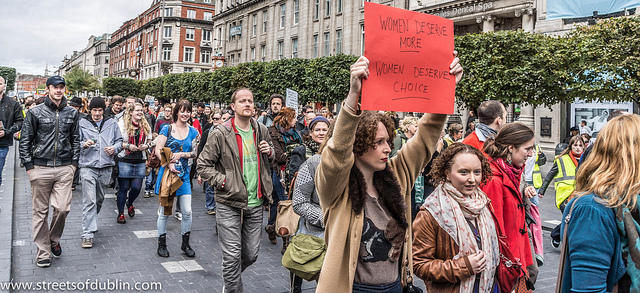
La Irlanda del siglo XXI está discutiendo sobre la libertad de decisión de las mujeres sobre su propio cuerpo. El 25 de mayo los irlandeses tendrán la primera oportunidad en 35 años de revisar una de las leyes más estrictas de Europa sobre la interrupción voluntaria del embarazo puesto que hoy solo se permite en caso de que la vida de la madre esté en riesgo.
A las personas con derecho a voto se les preguntará si desean derogar la octava enmienda de la Constitución, que se aprobó en 1983 y que consagra el derecho a la vida tanto de la madre como del no nacido. Si la población diera su aprobación, esta enmienda se substituiría por un texto que habilitaría al Parlamento a legislar sobre el aborto.
En este ambiente de debate y discusión en la sociedad irlandesa aparece Autonomy, publicado por New Binary Press, Cork, Irlanda, en 2018. Este libro, que se presenta en sociedad el 13 de abril, es un recopilatorio de poemas y ensayos reunidos por Kathy D’Arcy, poeta que se ha especializado en estudios sobre mujeres en la Universidad de Cork y con dos poemarios en su haber, Encounter (Lapwing 2010) y The Wild Pupil (Bradshaw 2012).
Estos textos hablan tienen un nexo en común: el respeto a la autonomía que ha de tener la mujer para decidir por sí misma, para elegir lo que ella crea conveniente, su libertad para tener control sobre su propio cuerpo. Decisiones que no siempre serán las correctas, pero que han de ser suyas, de nadie más.
Unwanted presence in my body
Cells the size of a sesame seed
In MY womb.
Not the womb of Irish politicians
Who will never know
Of the pain previous pregnancies ravaged on my body
The decade of sleepless nights
Of worrying about having money to pay for school trips and shoes
And wrapping kids in sleeping bags during freezing winters
When I had no money for oil.
Of the increased chances of something being very wrong
At my age.
14 years in jail I face
Because Ireland expects women to bear
The costs,
The responsibility,
The care,
The trauma
Of carrying an unwanted pregnancy to term.
I tell my teenage daughter
And she is scared.
Not of abortion pills
14 times safer than pregnancy
But of her mother going to jail.
Irish politicians
Making an already distressing
Situation worse.
«Pregnant in Ireland», Taryn de Vere
Estos textos recogidos por Kathy D’Arcy ayudan a reconocer y a luchar por algo que debería ser obvio: el derecho de la mujer a decidir por ella misma.
La lectura de estos poemas e historias me han transportado a finales de los años 70 en España, cuando una amiga que se había quedado embarazada me pidió que la ayudara. Como yo era el único del grupo que sabía inglés, me puse en contacto con una clínica en Londres y le solucioné todos los trámites para poder abortar allí. Cuando volvió, los hombres del grupo dejaron de hablarme, me consideraron un traidor porque la había ayudado a llevar a cabo la decisión que libremente ella había tomado (y que era contraria a la del padre). Esa fue una de las primeras veces en las que fui tachado como ‘traidor’ a la causa masculina (si es que esa causa existe).
I know a woman
Who made a choice
Whose reason is her own
Her country sent her across the sea
The State didn’t want to know.
‘I Know a Woman’, Yvonne Aherne
En la introducción del libro, D’Arcy nos cuenta como a raíz del descubrimiento de un trabajo escolar de su tía en el que entrevistó a su abuela, supo que ésta siempre quiso estudiar, pero como mujer no pudo hacerlo (solo pudieron estudiar sus hermanos) y ella acabó teniendo 16 hijos. D’Arcy nos comenta que ella será la primera mujer de su familia capaz de decidir si quiere o no quedarse embarazada (¡en 2018!). Dedica este libro a su abuela Alice y a todas aquellas mujeres que han tenido que abandonar su país avergonzadas, que se han arriesgado a acabar en prisión por haber abortado, a aquellas mujeres que en momentos delicados en los cuales necesitaban comprensión y cariño, solo recibieron crueldad e ignorancia.
Los diferentes ensayos, poemas y artículos ofrecen perspectivas diferentes sobre lo que la ‘autonomía sobre el propio cuerpo’ significa para las personas de a pie (personas LGBT, migrantes, madres, intelectuales, discapacitadas, …). Este libro quiere ser un empujón más para que el referéndum de mayo haga de Irlanda un país más libre y con ello conseguir una Europa más libre también.
He escogido solo algunos versos y poemas breves, puesto que nuestra revista es de poesía, para ilustrar el contenido del libro:
Each time we pass that hill
I see a pregnant woman
On her back,
The valley of her neck
Orbed belly to the sky
Green pelt, forest limbs
Howling the language of birth
‘Kindling’, Sinéad Gleeson
CC, William Murphy, flickr
Fógraím cogadh feasta
ar fhearaibh uile Éireann,
ar na leaids ag na cúinní sráide
is iad ina luí i lúib i gceas naíon,
a bpilibíní gan liúdar
is gan éileamh acu ar aon bhean
ach le teann fearaíochta is laochais
ag maíomh gur iníon rí Gréige
a bhí mar chéile leapan aréir acu,
is fógraím cogadh cruaidh feasta.
‘Labhrann Medb’, Nuala Ní Dhomhnaill
War I declare from now on all the men of Ireland on all the corner-boys lying curled in children’s cradles their willies worthless wanting no woman all macho boasting last night they bedded a Grecian princess – a terrible war I will declare.
‘Medb Speaks‘, Traducido por Michael Hartnet
the first time your boyfriend
thrusts
his burning penis in your hand;
when he waits until you are
drunk enough
to teach you the ways of men
pats you on the head, afterwards,
calls you a ‘good girl’
‘Matryoshka’, Nicola Moffat
Dear Frank,
I don’t like when Uncle Martin stands too close to me. I’m glad he lives in the basement. He’s wobbly and his breath smells like Chlorox. I’ll tell Dad when we’re driving to church on Sunday. (Frank de Sue Norton)
But you need to remember,you are not measured by the number on the scale because you can’t put a number on greatness you will always be greater than, not equal to or less.
‘> (Greater Than)’, Megan Cronin
Bruises and scars are so unladylike
But so was speaking out of turn.
It was unladylike to have rights
It was unladylike to fight
It was unladylike to go out at night.
Being ladylike has gained a new meaning
Being ladylike is being breakers of glass ceilings
Being ladylike is expressing my feelings
So how dare someone try to confine me
When I came out kicking and screaming
‘Ladylike’, Megan Cronin
We must stand together
Only then can we defeat them
Monsters and men who claimed our bodies
Each one taking a different piece of us and now it’s time for
them to stop
Never must we indulge the silence they left us in
Anyone who hears us will support our plea
Rest assured you are not alone, there are many more like you
& me
Equally broken but ready to reclaim what was stolen from us
Strength will scare them
Truth will eat them alive
Rights will be made at last
Oblivious eyes will be opened
Never will they stop our endless plea
Gone are the days when they owned us, now I own me
‘W.O.M.E.N A.R.E S.T.R.O.N.G’, Chloe Warmington
CC, William Murphy, flickr
Where are the women?
I ask the Strongman, the Acrobat, the Horses,
I ask the government, the comedians, the judiciary,
the scientists, the directors, the discussion panels,
Anna doubted that something as tiny as a lima bean could feel pain, even if
it did have a heartbeat.
She was positive that she could feel pain.
And she was certain that she could hide it, too.
‘Void’, Sue Norton
En un Poemareflexiona con… Aristóteles publicado hace unos días, comenté la existencia de un proverbio africano que dice: «Mientras que los leones no tengan sus propios historiadores, las historias de caza siempre glorificarán al cazador«. Lo mismo se podría decir de las mujeres, solo escribirán su propia historia si son capaces (y lo son) de decidir por ellas mismas.
Finalmente, solo nos queda desear mucha suerte a la sociedad irlandesa en su conjunto, no solo a sus mujeres, el próximo 25 de mayo. Su decisión tendrá repercusión en el resto de Europa en un momento de regresión de libertades que asuela el continente.
Los beneficios de la venta de este libro servirán para apoyar a aquellas personas o entidades que aseguren que todas las mujeres tengan acceso a todas las medidas sanitarias en el ámbito reproductivo, incluyendo la posibilidad de la interrupción legal y segura del embarazo.
The people of Ireland, today, in the twenty-first century, are engaged in a debate on the right of women to make decisions concerning their own bodies. On May 25, the Irish people will have the first opportunity in 35 years to modify one of the strictest laws in Europe on the voluntary interruption of pregnancy: abortion is currently permitted in Ireland only when the mother’s life is at risk.
Irish voters will be asked whether they wish to repeal the Eighth Amendment to the Irish Constitution, approved in 1983, a text that equates the right to life of a pregnant woman and that of her unborn foetus. If the voters approve the referendum, this amendment will be replaced by a provision enabling Parliament to pass legislation regulating the termination of pregnancies.
In this climate of debate and discussion in Irish society, New Binary Press has just published an anthology entitled Autonomy. Launched on 6 April in Cork, this book is a compilation of poems, stories and essays collected by Kathy D’Arcy, a poet who completed her academic work in women’s studies at Cork University. She has published two volumes of poetry, Encounter (Lapwing 2010) and The Wild Pupil (Bradshaw 2012).
The texts in this volume share a common element: respect for the autonomy women must have to decide for herself and freely make her own choices on the fundamental issue of the control of her own body. Such choices may not always prove to be the right ones, but every woman must be allowed to make her own decision.
Unwanted presence in my body
Cells the size of a sesame seed
In MY womb.
Not the womb of Irish politicians
Who will never know
Of the pain previous pregnancies ravaged on my body
The decade of sleepless nights
Of worrying about having money to pay for school trips and shoes
And wrapping kids in sleeping bags during freezing winters
When I had no money for oil.
Of the increased chances of something being very wrong
At my age.
14 years in jail I face
Because Ireland expects women to bear
The costs,
The responsibility,
The care,
The trauma
Of carrying an unwanted pregnancy to term.
I tell my teenage daughter
And she is scared.
Not of abortion pills
14 times safer than pregnancy
But of her mother going to jail.
Irish politicians
Making an already distressing
Situation worse.
—‘Pregnant in Ireland’ by Taryn de Vere
The publication of these texts helps women and men recognize and fight for a right whose existence should be self-evident: a woman’s right to choose.
Reading these poems and stories has taken me back to something that occurred in Spain in the 70s when a friend who was pregnant asked me for help. Since I was the only one in our social circle who knew English, I contacted a London clinic for her and negotiated the required procedures. When my friend returned, the men in the group stopped talking to me. They looked on me as a traitor because I had helped my friend to act on a decision that she had taken freely, but which was against the wishes of the father. That was one of the first times I was branded a «traitor» to the male cause (if such a thing exists).
I know a woman
Who made a choice
Whose reason is her own
Her country sent her across the sea
The State didn’t want to know.
—From ‘I Know a Woman’ by Yvonne Aherne
In her introduction, D’Arcy recounts how she came across a school assignment written by her aunt, who had interviewed her mother as part of a project. From this interview, D’Arcy learned that her grandmother had always wanted to study, but as a woman had been unable to do so—only her brothers were permitted this option. Instead, she had 16 children. D’Arcy goes on to say that she will be the first woman in her family truly able to decide whether or not she wants to be pregnant (in 2018!). She dedicates this book to her grandmother Alice and to all the women who have had to leave their country in shame, who have risked ending up in prison because of an abortion; all the women who, when facing a difficult situation, were in need of understanding and affection and were met only with cruelty and ignorance.
The essays, poems and articles in this anthology offer differing perspectives on what ‘autonomy over one’s own body’ means for ordinary people (LGBT+ people, migrants, mothers, intellectuals, people with disabilities, and others). Its publication is part of the effort to ensure that the May referendum will make Ireland a freer country and, in doing so, will achieve a freer Europe as well.
Since our magazine deals specifically with poetry, I have selected a few verses and short poems to illustrate the content of the book:
Each time we pass that hill
I see a pregnant woman
On her back,
The valley of her neck
Orbed belly to the sky
Green pelt, forest limbs
Howling the language of birth
—From ‘Kindling’ by Sinéad Gleeson
Fógraím cogadh feasta
ar fhearaibh uile Éireann,
ar na leaids ag na cúinní sráide
is iad ina luí i lúib i gceas naíon,
a bpilibíní gan liúdar
is gan éileamh acu ar aon bhean
ach le teann fearaíochta is laochais
ag maíomh gur iníon rí Gréige
a bhí mar chéile leapan aréir acu,
is fogran cogadh cruaidh feasta.
—From ‘Labhrann Medb’ by Nuala Ní Dhomhnaill
War I declare from now
on all the men of Ireland
on all the corner-boys
lying curled in children’s cradles
their willies worthless
wanting no woman
all male boasting
last night they bedded
a Grecian princess –
a terrible war I will declare.
—From ‘Medb Speaks’ by Nuala Ní Dhomhnaill (Translated by Michael Hartnett)
the first time your boyfriend
thrusts
his burning penis in your hand;
when he waits until you are
drunk enough
to teach you the ways of men
pats you on the head, afterwards,
calls you a ‘good girl’
—From ‘Matryoshka’ by Nicola Moffat
Dear Frank,
I don’t like when Uncle Martin stands too close to me. I’m glad I have lives in the basement. He’s wobbly and his breath smells like Chlorox. I’ll tell Dad when we’re driving to church on Sunday.
—From ‘Frank’ by Sue Norton)
But you need to remember,
You are not measured by the number on the scale
Because you can’t put a number on greatness
You will always be greater than,
Not equal to less.
—From ‘> (Greater Than)’ by Megan Cronin
Bruises and scars are so unladylike
But so was speaking out of turn.
It was unladylike to have rights
It was unladylike to fight
It was unladylike to go out at night.
Being ladylike has gained a new meaning
Being ladylike is being breakers of glass ceilings
Being ladylike is expressing my feelings
So how dare someone try to confine me
When I came out kicking and screaming
—‘Ladylike’ by Megan Cronin
We must stand together
Only then can we defeat them
Monsters and men who claimed our bodies
Each one taking a different piece of us and now it’s time for
them to stop
Never must we indulge the silence they left us in
Anyone who hears us will support our plea
Rest assured you are not alone, there are many more like you
& me
Equally broken but ready to reclaim what was stolen from us
Strength will scare them
Truth will eat them alive
Rights will be made at last
Oblivious eyes will be opened
Never will they stop our endless plea
Gone are the days when they owned us, now I own me
—‘W.O.M.E.N A.R.E S.T.R.O.N.G’ by Chloe Warmington
Where are the women?
I ask the Strongman, the Acrobat, the Horses,
I ask the government, the comedians, the judiciary,
the scientists, the directors, the discussion panels,
—‘Of Mice and #MeToo’s’ by Shaunna Lee Lynch (Age 17)
Anna doubted that something as tiny as a lima bean could feel pain, even if
it did have a heartbeat.
She was positive that she could feel pain.
And she was certain that she could hide it, too.
—‘Void’ by Sue Norton
In a recent blog entry entitled “Poema reflexiona con … Aristotle”, published a few days ago, I cited the following African proverb: “Until the lions have their own historians, hunting stories will always glorify the hunter”. The same could be said for women: they will write their own story only when they are capable of doing so—and they are—and able to decide for themselves.
Finally, we can only wish Irish society as a whole—not just the women—good luck on 25 May. Their decision will have repercussions on Europe at a time when a climate characterised by reductions in individual freedom is sweeping the continent.
Profits from the sale of this book will go to support those working to ensure that all women have access to the full range of reproductive healthcare, including the possibility of safe, legal abortion. Click here to order the book from New Binary Press, Cork Ireland.
Published 11 April in Poémame (Spanish digital poetry publishing platform and critical review)

 En este ambiente de debate y discusión en la sociedad irlandesa aparece Autonomy, publicado por New Binary Press, Cork, Irlanda, en 2018. Este libro, que se presenta en sociedad el 13 de abril, es un recopilatorio de poemas y ensayos reunidos por Kathy D’Arcy, poeta que se ha especializado en estudios sobre mujeres en la Universidad de Cork y con dos poemarios en su haber, Encounter (Lapwing 2010) y The Wild Pupil (Bradshaw 2012).
